By this point in the series, you are probably seeing the bumps that can occur as cash moves through your business.
Months where things look good. Sales are coming in. The team is busy. Profit is positive. The business is working, yet cash is tighter than you expected.
At first it doesn’t make sense. If we are making a profit, cash should improve. Most of the time that is true. There are moments, however, when they don’t align
These are the important moments, when profit and cash stop telling the same story.
Growing businesses feel a different sort of pressure. You can have a profitable month and less cash at the end of it. The state of doing well, but creating risk.
This is where growth gets uncomfortable. Profit feels like the signal you should trust. It is what you look at to answer the question is this business working?
It is a good signal. It is not, however, the one that determines what happens next.
Cash does.
Profit tells you how the business is running. Cash tells you if you can afford to run the business that way. They are different things. They move at different speeds, driven by different forces, and they arrive at different times.
Profit is recorded when the work is done. Cash arrives when the invoice is paid. Profit reflects the month. Cash reflects everything in the month:
- timing of customer receipts
- payments to suppliers
- obligations that are due, and
- the decisions made three months ago that are still working their way through, the money in motion
This is why the two can disagree. Profit looks back at what happened. Cash shows what is in front of you.
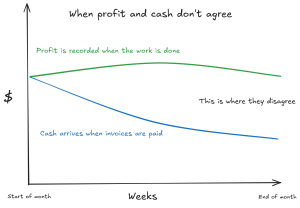
The chart above highlights why a business can be profitable and cash poor at the same time. The answer being, timing went differently than expected.
This is the part that catches out most founders and CEOs in growing businesses.
Decisions get made when profit looks good. A hire. More marketing spend. A new commitment. These are reasonable decisions. They are made on a signal that says the business is working.
The impact of those decisions shows up later in cash. By the time it arrives, the decision has already been made and implemented. The founder or CEO is no longer deciding. They are reacting.
Not because the decision was wrong. Because it was made using the wrong signal at the wrong moment.
Always remembering, profit tells you if the business works.
Cash tells you if the business can survive the way it works.
They are related. They are not interchangeable. Treat them as the same thing and eventually they will disagree with you. Quietly, then suddenly, in the way that the not so nice cash surprises arrive.
There is a saying that has stayed with me. Truth always wins, but truth goes last.
Cash is the truth of a business. Not the most visible truth, not the most immediate truth, not the truth that feels most real in the moment of a decision. The last truth. The one that arrives after everything else has had its say.
Profit speaks first. It tells you the work is good, the margins are there, the month was strong. Confidence follows. Decisions follow confidence. Then cash arrives last and tells you what was actually true all along.
This is not a flaw in how businesses work. I have seen this many times. It is not strange or unusual, it is simply the order of things. The problem is not that cash arrives last. The problem is making decisions as though it arrives first.
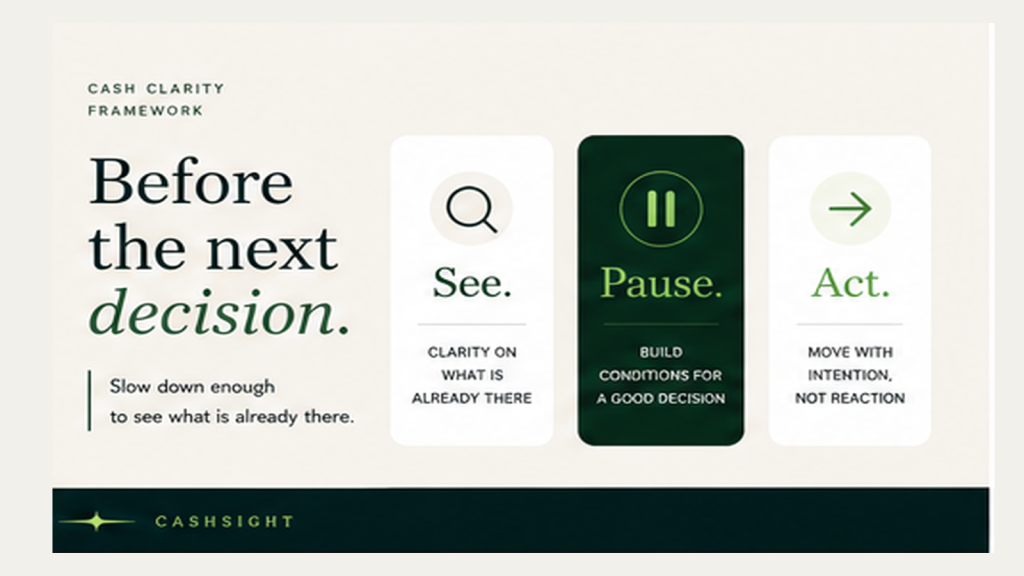
So before your next decision, there is a better question to ask.
We want profit to be positive and the bank balance to look okay. The question to ask, though, is if I do this, what happens to my cash?
Not in the long term. In the next thirty days, the next sixty or ninety days. In the weeks and months after the decision, when the cash impact has had time to move through the business and show itself.
Decisions don’t wait for clarity. Cash will always reflect them. It just does it last.
In the next article, a framework for making decisions before cash tells you the answer.