Most founders and CEO’s of growing businesses don’t ignore their cash. They are just moving too fast to see what it is showing them.
There is a difference. Ignoring is a choice. Moving too fast is what happens when you are running a business, holding the team together, delivering for customers, and making decisions without complete information. The signal is there. The picture is forming. The pace of the day means you catch fragments rather than the full story.
This is where most cash surprises begin. Not in a crisis or in a bad decision. In the ordinary momentum of a business that is working, where forward momentum outpaces the ability to notice what is already in motion.
The bank balance check captures a moment. What it cannot capture is what is already on its way.
So before you open a report, before you look at a number, before you make any significant decision, experience shows what you need to do first.
Slow down enough to see what is already there.
The framework
What follows is a practice for founders and CEOs who are responsible for cash decisions in growing businesses. It is not a financial checklist. It is a way of looking at the numbers with the right mindset. Clear enough to see them honestly, present enough to think with clarity, and grounded enough to act with intention rather than reaction.
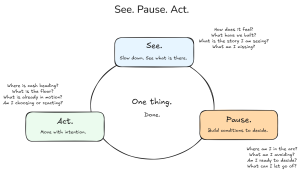
See.
Gain clarity on what is already there.
The business is always communicating. Revenue patterns, timing movements, the rhythm of money in and money out. It all tells a story if you stop long enough to look at it properly.
Most founders approach their numbers looking for confirmation. They want to know if things are okay. That is a good question, but a narrow one. It filters out everything that doesn’t fit the answer you are hoping for.
Gaining clarity on your cash means reframing the question. Moving from what does this confirm to what have I not been seeing.
That shift, from confirmation to curiosity, changes what you find.
The four See questions:
How does it feel?
Founders and CEOs have a feel for their business that no one else does. It is important to be regularly surfacing that feeling because you are the only one that can.
It is important to do that surfacing before you look at the reporting around your cash.
Name the feeling you have. Maybe it feels tighter, or easier, or more uncertain. Perhaps you are feeling more confident. The feeling is a signal, often the earliest one you have, arriving before the numbers catch up.
If something feels off and the numbers look fine, trust the feeling enough to look harder. Your instinct is picking up something your reports haven’t shown you yet.
What have we actually built?
Before you look at what is missing, look at what exists. The customers you serve now that you didn’t a year ago. The problems you have solved. The people in your team that show up.
Seeing this clearly is not a distraction from the cash work. It is the foundation for doing it well. Founders and CEOs who know what they have built have a clearer read on what they are protecting.
What is the story I am seeing?
Numbers report facts, stories carry meaning. A drop in cash is a fact. What caused it, what it signals, what it means for the next decision, that is the story.
Most founders read the facts and move on. The practice is staying long enough to see the meaning behind the numbers. That is where the real picture lives.
What am I missing?
This is the hardest question in the See stage and the most important one.
Not what do I know. Rather, what might I not be seeing. What assumption am I making that I haven’t tested. What has been moving quietly in the background, just beyond what I have been paying attention to.
The surprises that hurt most are almost never complete surprises in retrospect. The signal was there. There just wasn’t a moment to look at it properly.
This question creates that moment, before the surprise arrives rather than after.
Pause.
Build the conditions for a good decision to be made.
Here is something I have learnt about cash decisions.
The quality of the decision is determined less by the numbers and more by the state of mind you are in when you look at them.
This is not about being in a perfect state. We are imperfect people living in an imperfect world. Running a business will highlight that to you constantly.
Judgment and courage both need room to operate. They do not flourish under pressure. They contract. The Pause is the deliberate act of creating that room before the decision, not after.
Where am I in the arc?
Between the decision and the goal there is always a long middle stretch. A lull where things feel harder than they should, where the confidence of the original decision has faded and the outcome hasn’t arrived yet.
Are you building momentum? Are things clicking, decisions feeling clear, the business moving well? Or are you in the lull? Have you made decisions and are waiting for them to land, energy is lower than expected? Are you navigating something you didn’t plan for?
None of these are wrong. All of them are part of building something that is moving closer to the vision you set out to achieve. Knowing where you are changes how you respond. The founder in the lull who thinks something has gone wrong will react differently from the founder who recognises the lull as a natural part of the arc and stays oriented toward the goal.
What decision am I avoiding?
There is almost always one.
A hire you are not sure you can afford. A cost you are not sure is justified. A conversation with a customer that needs to happen. A financial number you have been moving too fast to look at properly.
Name it. Write it down if that helps. The decision you are avoiding is almost always the most important one to examine clearly. Avoiding it doesn’t make the cash impact go away. It just means you meet it unprepared.
Bringing it into the light, even before you have an answer, changes your relationship with it.
Am I in a state to decide well right now?
This is the question most founders skip entirely. It is also the one that would prevent more cash problems than any report or forecast.
A founder or CEO who is exhausted, overwhelmed, and holding too many things at once will look at the same bank balance as a founder or CEO who is rested, present, and clear, and they will make different decisions. Not because the number is different, it is what they bring to it that is different. A decision made from clarity looks different from a decision made from pressure. Even when the numbers are the same.
If you are running on empty, it is time to pause. Not forever. Just long enough to create space and think clearly. Protect that time the same way you would protect any other business critical activity.
What do I need to let go of to think clearly today?
Something is usually sitting in the background taking up space. A worry that is yet to resolve. A conversation that hasn’t taken place. A number that has been quietly unsettling you.
Name it, or even better write it down. You don’t have to solve it right now. Just acknowledge it so it stops sitting between you and clear thinking.
Act.
Move with intention rather than reaction.
There is a version of acting that is really just reacting with extra steps. You look at the numbers, something feels urgent, and you move quickly to resolve the feeling. The decision gets made but it is driven by pressure rather than judgment.
Then there is acting with intention. You have seen clearly. You have created the conditions to think well. Now you move, not because something is pushing you, but because you have chosen to.
That distinction matters. A chosen decision and a reactive decision can look identical from the outside. The difference is in what drives them and in what happens to the founder or CEO on the other side of them.
Not where is it today. Where is it likely to be in four weeks, eight weeks, three months.
The bank balance tells you where you are. This question tells you where you are going. If you cannot answer it you are navigating without a map, making decisions based on the present without knowing what is already arriving from the future.
What is your lowest cash point?
Not the average, the lowest point.
When does cash hit its tightest moment and what is the number at that point. Payroll, tax, supplier costs don’t land evenly. The question before any significant commitment is not do we have enough on average. It is can we meet every obligation at the lowest cash point.
Know the floor before you decide.
What is already in motion that I haven’t fully seen yet?
Customer invoices not yet collected. Costs yet to land. The cash impact of last month’s decisions still arriving.
The picture you are looking at right now is always incomplete. The question is how incomplete and what is on its way that you haven’t accounted for yet. This is the question that prevents most cash surprises. Not because it predicts them perfectly, but because it creates the habit of looking underneath the visible number.
If I make this decision, what happens in the next thirty days? In the next three months?
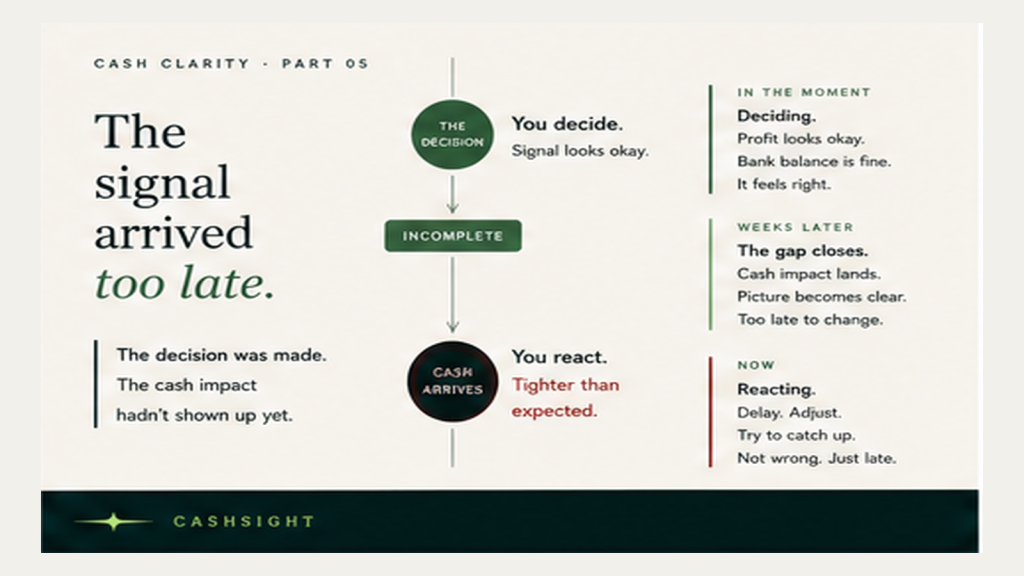
Most cash challenges don’t arrive immediately after a decision. They arrive three to six weeks later when the impact has had time to flow through. The decision feels fine in the moment. The bank account feels it later.
Before you commit, first write down what is coming. What does cash look like thirty days from now if you go ahead? What does it look like in ninety days? What does it look like if you wait? What does it look like if something else shifts at the same time?
You are not predicting. You are choosing with your eyes open.
Am I choosing this or reacting to it?
The final question before any commitment.
A moment of honesty before you move. Is this decision coming from clarity or from pressure. From intention or from momentum. From what you have seen and thought through, or from what feels urgent right now.
Only you know the answer. Asking the question, every time, changes the quality of what follows.
What the Act questions need
These four questions are simple to ask. They are harder to answer without the right picture in front of you.
- Where is cash heading requires a forward view, not just today’s balance.
- What is the floor requires knowing when obligations land and in what order.
- What is already in motion requires seeing what is sitting in your debtors, your creditors, your upcoming tax.
- What happens in the next ninety days requires running the scenarios before you commit.
Together they give you the picture that makes See. Pause. Act. possible in practice rather than just in principle.
The one thing
When you have worked through all of this, close with a single question.
What is the one thing I am going to do differently this month because of what I just saw?
One thing, specific and written down.
Maybe it is having a conversation you have been avoiding. Maybe it is running the scenario on a decision before you commit. Maybe it is protecting one hour next month to do this practice again. Maybe it is simply looking at cash weekly rather than when something feels off.
Then get that one thing done.
The practice is not the point, the decision is the point. This is how you get there.
What this is really for
Between starting and the goal there is a long stretch of work, hard work. You are constantly having to make decisions without complete information, in the middle of everything else, with the team watching and the bank balance fluctuating.
Most cash problems don’t begin in that work. They begin in the gap between moving and seeing, where the speed of building outstrips the ability to see what is already in motion.
The founders and CEOs who build the clearest relationship with their cash are not the ones who avoided the hard moments. They are the ones who develop the habit of slowing down long enough to look clearly at the business, at the numbers, at themselves, before they acted.
It is a habit that is learnable.
It starts with fifteen minutes and stepping through the questions. Then getting that one thing done.
See. Pause. Act.
Next: the four views that make the practice possible. Starting with where your cash is actually heading.