8 min read · Includes decision exercise
If you are a founder or CEO of a growing business, there are four things you need to make a cash decision with confidence.
- Where cash lands at the end of your forecast
- When it gets tightest
- Whether the revenue in your forecast is real. Everything else depends on it
- If the money already in motion in your business gives you room to act
If you understand the Big Four, you know how cash moves through your business. What I have experienced is that once founders and CEOs of growing businesses have this understanding, nothing of significance gets committed to unless all four are visible. The starting point is your bank balance, but it is the future direction of travel you are after. That is what the Big Four gives you.
One thing I find interesting is that with the Big Four, founders look to one of them first. I don’t know why this is, but my feeling is it depends on their personality and their previous experience.
One might go straight to the sales forecast, knowing that if that is right, cash will flow through. Another will go for the lowest cash point. They want to know when things will be at their most difficult, and they go to work from there.
The founders who look immediately at where the cash lands at the end of their forecast have a different mindset again. In this article, we will talk through this group and how they approach the first of the Big Four.
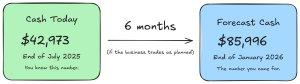
When looking at Where the Cash Lands, there are two numbers you are interested in. Current Cash and Forecast Cash. Unfortunately, it is not a straight line between the two.
Current Cash is what is in your bank account today. That one is certain and is your starting point. The second number, Forecast Cash, is where you are going. Somewhere in the future. 3 months, 6 months, 12 months. Whatever the period you are forecasting out to.
If you like the direction your forecast is showing you, push on with what you are doing. If you don’t like it, that is when you start making changes to correct your direction of travel.
If we take a step back, most founders I have worked with, and I include myself in this list, have made at least one significant decision they regret while using the bank balance alone as their anchor point. It might be a new hire, a capital investment, or a yes to a client that stretched the team. The bank balance looked fine and the business felt like it was going well. But the direction of travel of the business’s cashflow was telling a different story. It just was not visible yet.
The learning is this. If you haven’t put the work in to see where the Forecast Cash number lands, you are relying on your bank balance as your guide. Which means you know where you are, but without knowing the direction to head in, it’s just standing still with your eyes open.
The second number gives the direction of travel. It is the more important number.
I think of one founder I work with who told me she used to open her bank account and let that number tell her how to feel about her business. She doesn’t do that anymore.
When you see the second number clearly, with your own numbers, your own revenue, your own cost base, something shifts. If the number is good, there is a kind of permission that comes with it. You know you can move.
If the number is tight, you can feel that tightness within yourself. From that point though, a clarity seems to descend. That is because now you know. And knowing is always better than not knowing. You can begin to take action on what you can see. For me, this is one of the great moments in business. When a founder or CEO gets that sense of clarity and begins to move. There is a real power to it.
Now the bit you need to be comfortable with.
The second number, Forecast Cash, is not a guarantee. In fact, it is just about the opposite. It is almost certain you won’t hit that number at the end of your forecast period. That is because it is a forecast. The important thing you are looking for is the shape of the direction. If the shape is right, you are heading in the right direction.
Cash forecasts are built on your revenue assumptions, your cost patterns and your investment decisions. All of which can be challenged and adjusted. This is where founders who understand their business can change a variable in the forecast and watch what moves. The best leaders do this, giving themselves “what if” scenarios and alternatives to consider.
What if I can get new business in earlier? What if my largest customer delays their payment? What if I invest more in marketing or make a new hire?
I’ve worked with enough founders to know that the bank balance has a kind of emotional authority it hasn’t earned. We check it more than we should. We use it to assess how things are going when really it’s just a snapshot of everything that has already happened. It has nothing to say about what’s coming.
Founders and CEOs who break that habit are saying: current cash is now, forecast cash is next. These are two different things and you need both to make good decisions.
The bank balance tells you what happened. The forecast tells you what’s possible. This is what moves your business forward.
If I were to summarise this with an example:
| Cash today | $42,973 |
| End of July 2025. You know this number. | |
| Forecast — end of January | $85,996 |
| Six months ahead. This is the number you came for. |
When you do the work to develop a cash forecast, you see together both numbers we have been talking about. Current cash on the left. Forecast cash on the right. Not a guarantee of what will happen, a picture of the shape cash takes on the way there if the business trades as planned.
If you don’t like what you see, you can make changes because the forecast is built on assumptions. When you change the assumptions, the shape changes. That is the forecast working exactly as it should. The closing number gives you a direction, the shape tells you what it looks like to get there.
Founders and CEO’s of growing businesses who start using the second number find they cannot go back to the bank balance alone. Not because the bank balance stops being useful, they just now understand what it cannot tell them.
Decision exercise · Preview Co
The second number. August through January.
You are opening August. You already know the first number. You lived through July to get there. What you do not yet know is the second number. Where cash will be at the end of January if Preview Co trades as planned.
That is the number you came for. Go and find it.
Play: The second number →
Five minutes · No sign-up required · Uses Preview Co’s data
Coming next
Where it gets tightest. The number most founders wish they had seen earlier, and the date it arrives.